Beating the Clock: West Jefferson Medical Center’s Expert Stroke Care Keeps Local Runner in the Race
- Category: Stroke, Neuroscience, Brain & Spine Care
- Posted On:

On March 27, 2025, Antoine decided to go to work in support of a big project. A longtime runner and health-conscious 56-year-old, Antoine had no idea he was just hours away from experiencing a severe stroke.
“A month earlier, I had seen my primary care physician for an annual physical,” Antoine said. “My blood pressure, cholesterol, everything was normal. And, just two days before the stroke, I ran five miles because I was training for the Crescent City Classic 10K. No one saw the stroke coming, especially me.”
Antoine had just finished moving a piece of equipment and was getting out of his work truck, when he felt weak, like he couldn’t hold himself upright. He fell to the ground and struggled to stand back up.
“I can remember holding myself up with my right hand, and, in my mind, I was lifting my left hand towards the rail of the flat bed trailer hitched to my truck,” Antoine recalled. “At the time, my brain didn’t understand that I wasn’t really moving my left hand because that’s the side that lost function during the stroke. Eventually, my right arm gave out, and I was just laying there trying to get someone’s attention. There was a skeleton crew on second shift and a lot of noise, so I was on the ground for 15 to 20 minutes before someone spotted me.”
A coworker passing by in another truck saw Antoine and called in for help. Within minutes, Antoine was in an ambulance rushing to the closest hospital. Fortunately, the closest hospital was West Jefferson Medical Center, one of the region’s leading stroke care providers.
Every minute matters
“Antoine experienced classic stroke symptoms – one-sided weakness, facial drooping, and slurred speech,” said Lucido Ponce Mejia, MD, an endovascular neurologist and medical director of stroke care at West Jefferson. “A quick assessment confirmed he was experiencing a severe ischemic stroke, caused by a large clot in a major blood vessel.”
When this happens, timing is everything. The faster blood flow is restored, the better the patient’s outcome. The national standard for emergency stroke treatment is 120 minutes from the time a patient enters the hospital to when blood flow is restored.
“Time is brain,” said Dr. Ponce. “More brain damage occurs the longer blood flow is obstructed, so it’s crucial that every person and department involved in emergency stroke care moves quickly and safely. After a CAT scan showed the size and location of Antoine’s clot, we rushed him to a procedure room.”
Under general anesthesia, Dr. Ponce conducted a mechanical thrombectomy, a technique that involves threading a catheter through an artery in the groin to reach and remove the clot. From the time Antoine reached the hospital to when the clot was removed was 78 minutes – well below the national standard.
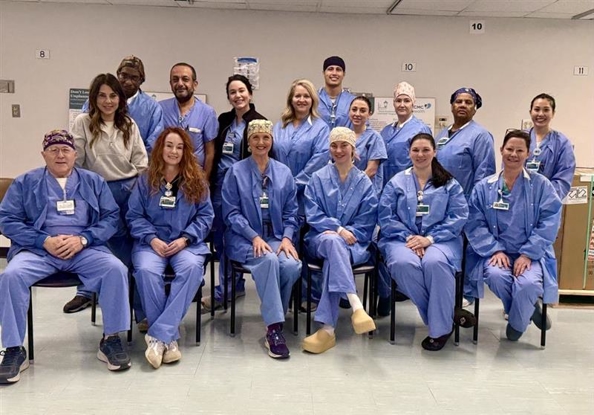
“I was especially proud of how our team handled Antoine’s care,” Dr. Ponce said. “He reached the hospital later in the day, when fewer staff are on-site, but that should not and did not affect his care. In fact, Antoine had one of the fastest after-hours reperfusion times at West Jefferson this year.”
Excellence in action
Cases like Antoine’s exemplify why West Jefferson is recognized nationally and locally for excellence in stroke care. West Jefferson is designated as a Comprehensive Stroke Center by the Joint Commission, which means the hospital is equipped to handle the most complex stroke cases. The hospital was also recently honored with the Get With The Guidelines® – Stroke Gold Plus Award by the American Heart Association.
“After I heard the full story about West Jefferson’s reputation in stroke care and how quickly they removed my clot, I was emotional and incredibly grateful,” Antoine recalled. “I know that so many people played a role in saving my life, and I just wish I could tell each of them thank you.”
Because of the team’s fast response, Antoine did not experience any permanent damage and did not require physical or speech therapy to recover. But his care didn’t stop there as everyone still wondered – what caused this healthy man with no risk factors to experience such a severe stroke?
Further testing revealed Antoine had a patent foramen ovale, or PFO, a common heart defect that occurs when a small hole between the upper chambers of the heart does not close properly after birth. Most people with a PFO experience no or mild symptoms, such as fatigue and shortness of breath. PFOs are also known to increase the risk of stroke.
Soon after the stroke, Antoine underwent a procedure to close the PFO and reduce his chance of experiencing a second stroke, which helped alleviate the daily anxiety he was facing.
“I live by myself, so I worried a lot about what could happen if another stroke occurred when I was alone,” Antoine recalled. “To overcome the anxiety, I focused on gratitude—for the care I received and the gift of every new day. I just kept reminding myself that I have to live life, not live in fear.”
Today, Antoine is back to work and running, again preparing for the Crescent City Classic 10K. He hopes to have several family members running the race alongside him to raise awareness about stroke prevention and the importance of recognizing stroke symptoms.
Remember BE FAST
“Someone witnessing a stroke has the first, most important step,” Dr. Ponce said. “If they don’t recognize the symptoms and get emergency medical care, it doesn’t matter how fast we are as a stroke care team—permanent damage could have occurred before the patient arrives at the hospital.”
BE FAST is an acronym that makes it easy to remember the common symptoms of a stroke:
- Balance – sudden loss of balance or coordination
- Eyes – sudden, persistent blurred or double vision, or other vision trouble
- Face – sudden numbness or weakness in the face or an uneven smile
- Arm – sudden numbness or weakness in arm or leg, usually on one side of the body
- Speech – sudden difficulty speaking
- Time = Brain – call 911
“I’m grateful for the opportunity to share my experience,” Antoine said. “I’m very blessed to have been in the right place at the right time. If I hadn’t gone to work that day, if my coworker hadn’t recognized my symptoms, and if I hadn’t been taken to West Jefferson, my story could have had a very different ending.”
“It sounds odd, but my goal is to be out of my patients’ lives as quickly as possible,” Dr. Ponce said. “Because that means that our entire team did their job well. Blood flow was restored quickly, resulting in minimal permanent damage, and our patients are able to return to who they were and what they were doing before the stroke. I’m very proud of the high quality, consistent stroke care our team provides.”
Stroke symptoms can appear without warning – knowing what to look for and where to go can save a life. Learn more about award-winning stroke care at West Jefferson Medical Center and how we’re here for you when every second counts.