The causes of kidney stones can vary, but they often result from the accumulation
of certain substances in the urine, such as calcium, oxalate, and phosphate.
Dehydration, dietary factors, and genetic predisposition can contribute
to the formation of kidney stones.
Treatment options for kidney stones depend on factors like the size and
type of the stone, the symptoms it causes, and the overall health of the
patient. The choice of treatment depends on the specific characteristics
of the kidney stones and the patient's overall health. It's important
for individuals experiencing symptoms of kidney stones, such as severe
pain, blood in the urine, or urinary tract infections, to seek prompt
medical attention for proper diagnosis and treatment.
If you are suffering from kidney stones and are looking for the right treatment
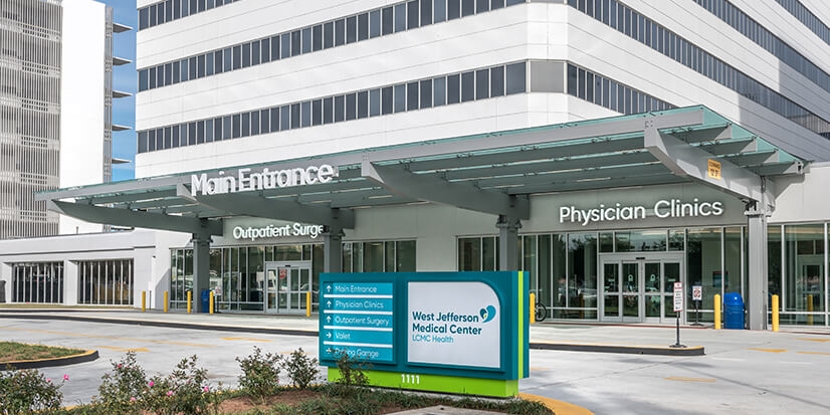
option, our urology team at West Jefferson Medical Center is here to help you.
Extracorporeal Shock Wave Lithotripsy (ESWL) is a non-invasive medical
procedure used to break down kidney stones into smaller pieces that can
be more easily passed through the urinary tract. This technique uses shock
waves generated outside the body to target and fragment stones within
the kidney or urinary tract.
ESWL consists of three steps.
Shock Wave Generation: The patient lies on a treatment table or in a water-filled tub, and a
machine generates shock waves outside the body.
Focused Shock Waves: The shock waves are directed precisely toward the location of the kidney
stone using imaging techniques such as ultrasound or fluoroscopy.
Stone Fragmentation: When the shock waves reach the kidney stone, they break it into smaller
pieces. These smaller fragments can then pass out of the body more easily
through the urine.
Ureteroscopy is a minimally invasive procedure that is commonly used for
the diagnosis and treatment of various urological conditions. It involves
the use of a thin, flexible tube called a ureteroscope, which is passed
through the urethra and bladder to reach the ureters or kidneys. The ureteroscope
is a long, flexible tube with a light and a camera at the tip allows the
urologist to visualize the structures of the ureters and kidneys on a
monitor. This real-time imaging helps identify any abnormalities, such
as stones, tumors, or other blockages.
If a kidney stone or other obstruction is identified, the urologist may
perform additional procedures during the ureteroscopy. For example:
Laser Lithotripsy: Laser energy can be used to break down kidney stones into smaller fragments,
making them easier to pass.
Stone Retrieval: small stones or stone fragments can be removed using a basket-like device
at the end of the ureteroscope.
Biopsy or Treatment of Tumors: Ureteroscopy allows for the collection of tissue samples (biopsy) or the
treatment of tumors within the urinary tract.
Percutaneous Nephrolithotomy (PCNL) is a surgical procedure used for the
removal of large kidney stones or multiple smaller stones that cannot
be effectively treated with less invasive methods like shock wave lithotripsy
or ureteroscopy. Percutaneous Nephrolithotomy is an effective method for
treating large kidney stones, and it has a high success rate.
PCNL involves making a small incision in the back to access the kidney
directly and remove or break down the stones. A thin tube called a nephrostomy
tube is then inserted through the incision and into the kidney. This tube
provides a passageway for instruments and allows the surgeon to access
the stones. Once the tract is dilated, specialized instruments, such as
nephroscopes and laser fibers, are introduced through the nephrostomy
tube. The surgeon visualizes the stones using a nephroscope (a tube with
a light and camera) and can then either remove the stones intact or use
laser energy to break them into smaller, more manageable pieces.








.jpg)