UNIVERSITY MEDICAL CENTER NEW ORLEANS BECOMES ONLY HOPSPITAL IN GULF SOUTH TO HOLD TRIPLE CROWN OF EMERGENCY CARE DESIGNATIONS
- Category: News
- Posted on:
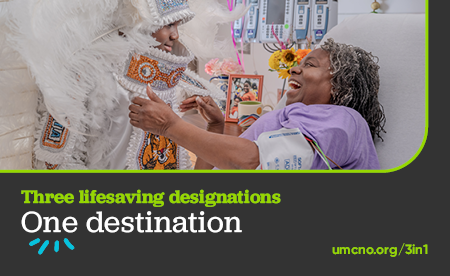
These certifications solidify UMC as a destination healthcare facility, with three critical designations under one roof
University Medical Center New Orleans (UMC) announced today that it has become the only hospital in the Gulf South to simultaneously hold the region’s three highest national emergency care designations: Level I Trauma Center, Verified Burn Center and Comprehensive Stroke Center.
These three life-saving designations in one destination ensure that patients facing the most critical moments no longer face fragmented care. By housing these elite specialties under one roof, UMC provides a singular destination where coordinated teams and advanced technology are readily available around the clock.
"As we step into 2026, we are sending a clear message: Tomorrow Starts Here," said Tom Patrias, Chief Executive Officer of UMC. "In a region where trauma and stroke rates significantly exceed the national average, providing equitable access to this level of specialized care isn't just a clinical achievement, it’s a community necessity."
While the designations reflect institutional rigor and expertise from our academic partners, LSU Health and Tulane School of Medicine, leadership emphasizes that the heart of this milestone is the hospital’s workforce.
"National designations are earned on paper, but they are proven every day at the bedside," said Dr. Jeffrey Elder, Chief Medical Officer of UMC. "This significant achievement is only possible because of our incredible UMC team members. These are professionals who show up, take care and choose excellence every single day. Their refusal to settle for 'good enough' is why we are now the premier destination for lifesaving care in the Gulf South."
As the state’s flagship academic medical center and safety-net hospital, UMC provides this world-class care to all patients regardless of their background or ability to pay, directly addressing health disparities across zip codes.
.png)