Steve’s Scroll of Gratitude: A Story of Advanced Heart Care and Compassionate Teamwork
- Category: Heart & Vascular, Heart Care
- Posted On:
When Steve Schysm arrived at East Jefferson General Hospital in June 2025, he was exhausted, running out of options, and in need of advanced cardiac care. What began as a difficult Father’s Day weekend escalated quickly. Severe physical weakness, a struggling heart, and the collapse of a stent that had been placed just months earlier all happened at once.
In the days and weeks that followed, Steve faced the aftermath of a heart attack, multiple procedures, and a physically demanding recovery. As his condition worsened, he ultimately underwent open heart surgery and received a life-saving Left Ventricular Assist Device (LVAD), a mechanical pump designed to support hearts that can no longer circulate blood effectively on their own.
Throughout his care, he was supported by a team that would come to define his experience. Clinicians steadied him, encouraged him, pushed him forward, and reminded him every day that he was not alone.
As Steve began regaining strength and prepared to leave the Surgical Intensive Care Unit (SICU), he did something deeply personal. He wrote a scroll. A long, poetic, funny, heartfelt tribute to the multidisciplinary care team he affectionately called his “kingdom.”
“Writing it was my way of saying thank you,” Steve said. “I had been told there wasn’t much more anyone could do for my heart. I knew it was time to either try something different or accept what was coming. The team at East Jefferson was the best group of people I’ve ever been around. I can say with confidence they saved my life.”
A heart in crisis and the LVAD that changed everything
Steve’s journey to East Jefferson General Hospital was the result of a complicated history with heart disease. Now 62, he had been living with the effects of a prior heart attack for more than 25 years, along with ongoing damage that gradually weakened his heart’s ability to pump effectively. Over time, medications and procedures helped manage his condition, but his heart could no longer keep up.
Steve learned that his heart function had declined to a point where conventional treatments were no longer enough. A transplant evaluation was considered, but the outlook was uncertain. His heart was too weak, and the timeline too unpredictable.
What he needed was a different kind of solution. One that could stabilize his condition and give his body the support it needed to recover.
That option was a Left Ventricular Assist Device.
“For Steve and patients like him, an LVAD can restore circulation and take over much of the heart’s workload when it can no longer do so on its own,” said Sasa Vukelic, MD, PhD, the East Jefferson cardiologist who oversaw his care. “These devices can provide meaningful support, often lasting close to 15 years, and give patients the time and stability they need to regain strength and focus on recovery.”
Steve had open heart surgery at East Jefferson General Hospital, where the cardiology and surgical teams implanted the device. The procedure was performed by Jamil F. Borgi, MD, a cardiothoracic surgeon, and marked a critical turning point in Steve’s care.
During an LVAD procedure, surgeons implant a small mechanical pump that helps the weakened left side of the heart move blood throughout the body. The device is attached directly to the heart and blood vessels and is powered by a small external system worn outside the body. An LVAD supplements the heart’s pumping ability and can help a person with advanced heart failure feel well enough to return to work and social activities.
Steve’s surgery was successful. But the days immediately following the procedure were medically complex. His body had to adjust not only to the effects of major open heart surgery, but also to relying on a mechanical device to support circulation.
He remained in critical condition and required intensive, round-the-clock monitoring as his care team carefully managed blood flow, blood pressure, and overall organ function. This period was focused on stabilization and close observation, ensuring the LVAD was functioning properly and that Steve’s body was responding as expected.
The SICU that became a “kingdom”
Steve remained in East Jefferson’s Surgical Intensive Care Unit, where patients with complex, high-acuity needs receive continuous, specialized care. For Steve, the SICU became home for the next 10 weeks.
The SICU team included nurses, advanced practice providers, respiratory therapists, physical therapists, and physicians working together around the clock. In addition, Steve was closely followed by Cristina Sanina, MD, an interventional cardiologist who played a central role in his care during his SICU stay.
Dr. Vukelic, Dr. Borgi, and Dr. Sanina worked closely together as a unified care team, coordinating care across disciplines and helping guide Steve through a prolonged stay. The close collaboration among his physicians stood out immediately.
“Everybody worked together as one team,” Steve said. “There was mutual respect and constant communication. That level of coordination made me feel supported and secure throughout my care.
They were always on the same page.”
As his stay continued, Steve grew familiar with the unit and the caregivers around him. The consistency of the care team and the relationships he formed helped support him through periods of physical weakness and uncertainty. Recover progressed gradually, marked by small but meaningful milestones over time.
It was during this stretch that Steve began to take note of the people around him — not just what they did, but how they showed up for him day after day. That attention would later take shape in his writing.
That consistency was driven in large part by the nursing team. Some pushed him when he needed it most. Some decorated his room for his birthday. Some brought cupcakes. Many found small ways to lift his spirits on the days he felt weakest.
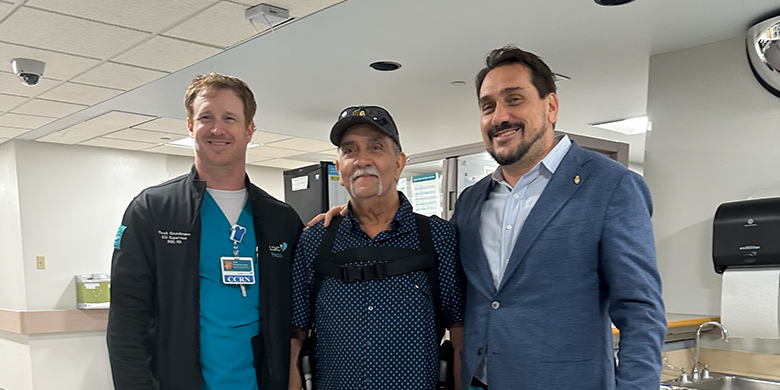
He formed an especially strong bond with Rock, a charge nurse whose calm, reassuring presence became a source of comfort for both Steve and his fiancée, Mary. They said that Rock could sense when something was off before monitors ever did. He advocated for Steve, listened to him, and helped keep him focused and motivated throughout recovery. The two still keep in touch today.
Small acts of kindness mattered deeply, too. Two nurses even helped Steve put on his socks during the weeks when he needed assistance with nearly everything. It was a simple act, but one he remembers clearly because it restored a sense of dignity during a time when independence felt far away.
When Steve grew restless after weeks indoors, nurses wheeled him outside on three separate occasions so he could feel sunlight and fresh air. For an outdoorsman who loves fishing, hunting, and camping, this time outside meant everything and helped lift his spirits when recovery felt slow.
Mary remembers the care just as vividly, including David, a night nurse who was there during one of Steve’s most frightening moments. When Steve became disoriented and experienced sudden bleeding, David acted quickly and calmly, helping prevent what could have been a bigger emergency.
“The nurses saved him,” Mary said. “They saved us.”
Over time, Steve began to see the SICU not just as a place of intensive medical care, but as a community defined by teamwork, trust, and humanity.
It was during this stretch that he began to write his scroll.
What started as a way to pass time became something far more meaningful. A scroll filled with humor, gratitude, and vivid descriptions of the people who surrounded him each day. In it, he described the SICU as his “kingdom,” guarded by quiet heroes in scrubs and steady hands that never left his side.
Recovery, return home, and ongoing care
When Steve was strong enough to take the next step forward, he was discharged and remained in Metairie for about a month so the East Jefferson General Hospital team could closely monitor his medications and early LVAD recovery. From there, Steve and Mary returned home north of Lake Charles, where the focus shifted to rest, physical therapy, and rebuilding strength.
Life with an LVAD requires daily care and attention, but Steve was well prepared before returning home. His care team provided hands-on education so he knew what to expect and how to manage the device with confidence. At home, this includes keeping the small exit site clean, checking his LVAD equipment daily, and taking medications that support healthy blood flow and reduce the risk of complications.
Steve remains in regular contact with his East Jefferson General Hospital team and returns for scheduled follow-up visits so they can monitor how the device is working and how his body is adjusting. His care is also closely coordinated with his physicians back home, ensuring a shared plan across teams and continuity between visits. This collaborative approach allows Steve to continue healing close to home while staying connected to the specialized cardiac expertise that supports his long-term recovery.
He continues with rehabilitation and physical therapy, gradually increasing activity as his endurance improves. After losing nearly 60 pounds, Steve is now focused on regaining strength and weight in a steady, healthy way.
Steve has also shared what he learned with others facing similar diagnoses, offering reassurance about the road ahead and emphasizing the importance of staying engaged, asking questions, and trusting the care team along the way.
The scroll he wrote during his time in the SICU remains a meaningful reflection of that experience.
“It helped me put everything into words,” Steve said. “Not just what happened medically, but what it meant to have people show up for me every single day. For anyone considering an LVAD, this is the kind of team you want by your side.”
Today, Steve sees East Jefferson General Hospital not only as the place where he received advanced cardiac care, but as the place that gave him time, stability, and a path forward. While specialized heart care was not available closer to home, he remains deeply grateful that his local physician knew where to send him and that the East Jefferson team was ready when he arrived.
To learn more about advanced cardiac care, LVAD support, and Surgical Intensive Care services at East Jefferson General Hospital, visit the Heart and Vascular Care webpage.