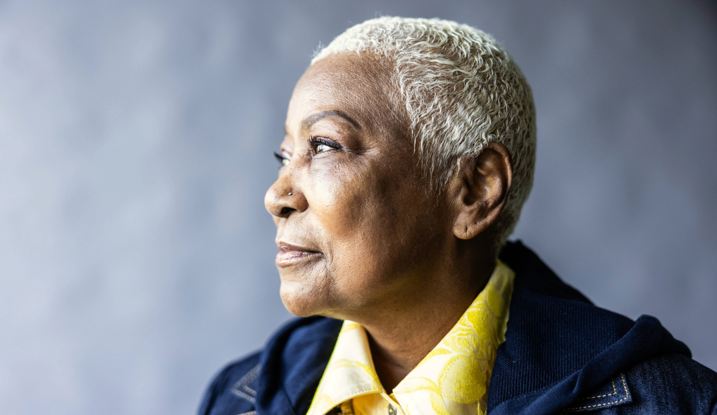
When the ICU nurse became the patient: Jennifer’s stroke journey at East Jefferson General Hospital
- Category: Stroke, Rehabilitation, Stroke Care
- Posted on:

Jennifer Coates Hewitt, 62, has been caring for critically ill patients at East Jefferson General Hospital in Metairie, La., since 1990. She is a charge nurse in the hospital’s Medical and Surgical Intensive Care units.
She loves her work, but her favorite place to be is underwater. For more than three decades, Jennifer has traded her scrubs for a SCUBA wetsuit whenever she can. She volunteers as a SCUBA diver at the Aquarium of the Americas. In fact, on December 7, 2025, Jennifer was driving to work with her mind on a bucket-list diving adventure in Wakatobi, Indonesia, planned for November 2027.
As she was driving the 45-minute trip to work across the Lake Pontchartrain Causeway, thoughts of her trip were replaced with a strange sensation in her right eye. It was 6:15 a.m. and she recalls that she “just didn’t feel right.”
Comprehensive stroke care at East Jefferson General Hospital
By the time she arrived at work, Jennifer was experiencing vertigo, a sensation that the room was spinning. She had to grab the railing for balance, and by the time she reported to the unit for her 7 a.m. shift, she was experiencing double vision.
“I couldn’t see my patient’s lab results clearly on the computer screen at all. I knew something was definitely not right,” Jennifer said.
When she tried to explain to her colleagues what was happening, they quickly realized this was more than blurry vision. Jennifer was placed in a wheelchair and taken directly to the emergency department, where the care team immediately activated a “stroke alert.”
East Jefferson General Hospital has earned the highest level of stroke care certification a hospital can receive. It has been named a Comprehensive Stroke Center by the American Heart Association. This certification means patients can feel confident that stroke care at East Jefferson General Hospital meets rigorous standards for rapid diagnosis and treatment.
In stroke care, “time is brain”
A stroke alert is a hospital-wide emergency response that mobilizes physicians, nurses, imaging staff, and pharmacists within minutes – when a stroke is suspected.
Jennifer said she remembers hearing stroke alerts in the hospital for years. “This time I heard it very differently because I knew it was about me! I couldn’t believe I was having a stroke,” she said.
Jennifer was immediately taken to radiology where she underwent a CT scan, a specialized X-ray that creates detailed cross-sectional images of the brain.
Still the neurologist who evaluated Jennifer recommended she take Tenecteplase, also known as TNK. He told Jennifer that his stroke assessment revealed stroke symptoms and that he believed TNK, which is the preferred treatment to dissolve blood clots, was necessary.
She agreed to take the TNK because she knows “time is brain.” When it comes to stroke care, every minute counts because, during a stroke, blood flow to the brain is interrupted. Without blood, brain cells begin to die within minutes.
As soon as the stroke alert was called, Aimee M. Aysenne, MD, a neuro intensive care physician at East Jefferson General Hospital and associate professor of Neurosurgery at Tulane University School of Medicine, ran to Jennifer’s side in the Emergency Department. The two knew each other well having worked together for years. Dr. Aysenne said she believed Jennifer was having a stroke based on her symptoms and clinical exam.
“Stroke is not usually seen on the initially CT scan because it takes hours before we can detect the damage to the brain, and by that time, it is too late for treatment. We rely on the patient’s history and clinical exam to determine next steps of treatment,” Dr. Aysenne explained. “Jennifer’s right eye was fixed and she said she was experiencing double vision and her symptoms were fluctuating rapidly including slurred speech and weakness on the left side of her body. She was having an acute evolving stroke before our eyes.”
Since Jennifer had taken the TKN already, Dr. Aysenne focused on finding the location of the blood clot. An MRI led to a definitive diagnosis of a right pontine infarct. An infarct is an area of tissue damage caused by lack of blood supply. The right pontine is located in the brain stem and having a stroke in this part of the brain can be life-threatening and often causes severe disability.
Following “Get With the Guidelines” stroke protocol
Dr. Aysenne and her team were doing everything possible to treat Jennifer in accordance with the American Heart Association and American Stroke Association’s Get With The Guidelines® program. East Jefferson General Hospital has also earned the organization’s Stroke Gold Plus Quality Achievement Award, which recognizes hospitals committed to ensuring stroke patients receive the most appropriate, evidence-based care.
About an hour after receiving TNK, Jennifer’s condition changed abruptly. Her blood pressure dropped to a dangerously low level, and her pulse slowed to just 20 beats per minute.
“I was experiencing intense pain, and I could feel the paralysis setting in,” she said. “I couldn’t move anything on the left side of my body.”
Although the stroke was already evolving, early treatment likely reduced the extent of permanent damage, Dr. Aysenne said.
Jennifer was admitted to the Neuro Intensive Care Unit for five days on December 7, 2025. By December 12, she was transitioned to inpatient rehabilitation for a week under the direction of Brian W. Peterson, MD, a neurologist and the director of the East Jefferson Inpatient Rehabilitation Center.
While going through rehabilitation, Jennifer gained a deeper appreciation for the stroke care at East Jefferson General Hospital. After caring for countless critically ill patients over the years, becoming a patient herself gave her a new perspective.
“These are my colleagues,” she said. “I already knew they were wonderful. This time I saw it from the patient’s perspective. They went beyond to help me, and they did it very quickly. I had my stroke in the right place. If I had been elsewhere, I could have had a very different outcome.”
In Home and Outpatient Therapy Helps Jennifer Rebuild Strength
After being discharged from the hospital, Jennifer began home health rehab right away. She continued following the treatment plan outlined by Dr. Peterson, which included physical therapy to improve strength and mobility and occupational therapy to help with daily activities such as dressing and bathing while she worked to regain strength in her left arm and leg. Speech therapy is also helping her return to her normal speech pattern.
On January 13, 2025, Jennifer began outpatient therapy at Lakeview Hospital’s Rehabilitation and Sports Medicine Center in Mandeville, La., closer to her home. She receives all three rehabilitative therapies in 45-minute sessions, twice a week. She is also participating in aquatic therapy, which uses water resistance to improve balance and strength.
“I love the water and can’t wait to get back to diving,” Jennifer said, “so I’m happy to do aquatic therapy all the time.”
Recovery takes time
Jennifer continues to use a walker for longer distances and a cane at home. Fatigue requires rest and she still has significant weakness on her left side. Luckily, she has regained full vision and cognitive function. She fully expects to get back to the life she loves in time. And, of course, she plans on going on the Indonesia trip regardless of where she is in her recovery.
“All this damage happened in three seconds,” she said. “It will take much longer to get back to being 100 percent.”
She hopes to return to work once she can safely provide the level of care her patients require. Until then, she focuses on steady progress, one therapy session at a time.
Jennifer reflected back on the care she received from her colleagues.
“As soon as they heard what had happened to me, so many physicians and nurses came to see me every day. These people are like my family; I’ve known them for half of my life,” she said. “Someone was always stopping by to check on me. I was never alone, and knowing there were so many people who cared so much really made a difference. I truly appreciate all their love and support.”
To learn more about East Jefferson General Hospital’s Comprehensive Stroke Care Center, visit: https://www.lcmchealth.org/east-jefferson-general-hospital/our-services/stroke-care/
To learn more about Lakeview Hospital’s outpatient rehabilitation services visit https://www.lcmchealth.org/lakeview-hospital/our-services/rehabilitation-services/