From Paramedic to Patient: How Level I Trauma and Surgical Teams Across Three LCMC Health Hospitals Rebuilt Kenny’s Life After Catastrophic Injury
- Category: Patient Story
- Posted on:

Kenny Knowles, 66, spent most of his life on the front lines of emergency care. For nearly four decades as a paramedic in New Orleans, he responded to trauma, stabilized patients, and moved them quickly into hospital systems built to save lives.
On August 20, 2025, he became a patient.
Kenny arrived at work before his 7 a.m. shift. That day, he was posted at the firehouse. At 6:55 a.m., he and his partner got a call that a school bus and car were in an accident. He walked out of the firehouse to jump into the ambulance and a minute later—at 6:56 a.m.—the unthinkable happened.
It was at that very moment that a driver lost control of his vehicle. Police said he fell unconscious behind the wheel. The car entered the firehouse parking lot at 60 mph and struck Kenny, sending his body flying through the air, Kenny’s partner later told him. In fact, his partner saw the whole incident.
“He said I landed a full 80 feet away,” Kenny said. “He admitted to me that, at that moment, he didn’t think I was going to live through it. I know there is video of the incident and no one will let me even watch it.”
Bloody and broken, Kenny did survive the crash. But the nightmare wasn’t over. The out-of-control vehicle hit four cars in the parking lot before veering right to where Kenny’s body landed. The car then dragged Kenny another 30 feet before slamming into the side of the firehouse.
Kenny’s friends and colleagues, his fellow paramedics and firefighters, extricated him and initiated care. He was transported to University Medical Center New Orleans, a Level I Trauma Center, where a full trauma activation was underway.
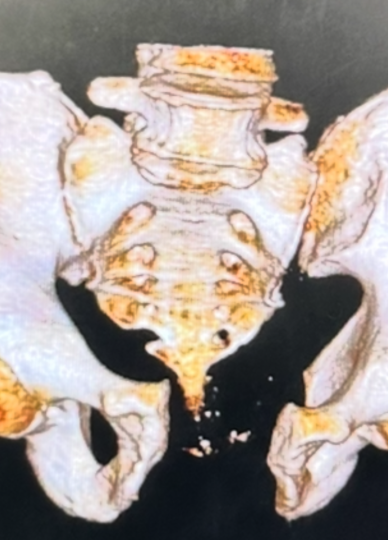
On arrival, Kenny’s condition was critical. His blood pressure dropped to approximately 50 over 20, indicating severe shock. Trauma teams moved immediately to stabilize him. He sustained an open book pelvic fracture, which means the pelvis was split apart at the front. Kenny was bleeding internally.
He also suffered an open fracture of the right leg, severe ligament and tendon damage in the left leg, multiple rib fractures, and significant soft tissue injuries. The top of his scalp was even sheared off.
As Kenny describes his own story—relayed to him by others long after August 20—he said he still cannot believe the severity of his injuries.
“And, somehow, I avoided major organ damage and permanent neurological injury,” he said. “Doctors told me that despite everything that happened, I was very lucky. No major organ damage meant I might get out of this whole thing alive.”
First surgery: Pelvic reconstruction
Daniel Miles, MD, an orthopedic trauma surgeon at University Medical Center and assistant professor of Orthopedic Surgery at Tulane University School Of Medicine, led the reconstructive surgery, stabilizing Kenny’s pelvis and right leg with titanium rods and screws. Without this hardware restoring alignment and stability, it’s likely Kenny may not have ever been able to walk again.
Meanwhile, Kenny was still sedated. He doesn’t remember the accident or much about the care he received at University Medical Center. He can, however, say without hesitation that Dr. Miles “did an incredible job fixing what the surgeon told his family was a severe pelvic ring injury,” Kenny said.
After a week of careful monitoring in the Intensive Care Unit (ICU), he was moved to a regular room for a couple of weeks to get stronger. Kenny finally woke up and was able to begin inpatient rehabilitation — enough to get out of bed and sit in a wheelchair.
This is when Kenny’s wife and family were able to feel a bit of relief, but they knew he wasn’t anywhere close to being out of the woods medically. Kenny was discharged on crutches, preparing himself mentally for his next surgery.
Surgery No. 2: Left leg reconstruction
All of the ligaments and tendons in Kenny’s left leg were shredded in the accident. Now, with his pelvis and right leg healing, it was time to address his left leg.
That’s when Wendell Heard, MD, a sports medicine specialist at Lakeside Hospital in Metairie, La. and associate professor of Clinical Orthopedics at Tulane University School of Medicine, took over Kenny’s case. Kenny said he couldn't praise Dr. Heard enough for his “amazing bedside manner and phenomenal surgical skills.”
By February 2026, Kenny’s bones including his pelvis, both legs, and four ribs had healed.
But his recovery journey was far from over.
Third surgery: Complex urologic reconstruction
Now it was time for the most complex phase of Kenny’s healthcare journey.
He required urologic reconstruction. Kenny had a prior history of urethral stricture, a condition where scar tissue narrows the urethra and restricts urine flow. He had spent many years requiring intermittent self-catheterization due to an injury he suffered 20 years ago.
Unfortunately, the pelvic trauma Kenny sustained in the August 2025 accident completely destroyed his urinary channel.
To relieve himself, Kenny required two types of catheters. Babak Azad, MD, a reconstructive urologist at East Jefferson General Hospital in Metairie, La. and assistant professor of Reconstructive Urology at Tulane University School of Medicine, managed this phase of his care.
Initially, Dr. Azad placed a suprapubic catheter, which drains urine directly from the bladder through the abdomen. This bypasses the urethra and allows injured tissue to rest and settle down. Definitive repair, however, required a urethroplasty, a highly specialized reconstructive procedure.
Dr. Azad completed the complex surgical reconstruction in a 10-hour operation.
“Dr. Azad used tissue from the inside of both of my cheeks to rebuild my urethral channel,” Kenny said. “I know this was an incredibly complex surgery… and I had the best doctor I could have possibly had.”
Kenny said Dr. Azad answered every question and was transparent about the uncertainty of recovery.
“Due to the extent of my injuries and all the scarring in my pelvic region, we really didn’t know if I would ever be able to urinate without a catheter,” Kenny said.
In fact, Kenny kept both catheters in for four weeks after Dr. Azad performed the urethral reconstruction to make sure that urine was able to be passed normally without leakage.
“I hated those two catheters and even started to believe I would never be able to go to the bathroom normally,” Kenny said. “But when Dr. Azad removed them, I was able to urinate normally. I couldn’t believe it. I can never truly tell him how much I appreciate the care he showed me.”
The reconstruction was a success restoring both physical function and quality of life.
Kenny described that moment as a turning point. After months of dependence on tubes and hospital care, he returned to a basic bodily function most people take for granted.
Kenny’s outcome reflected highly coordinated, multidisciplinary care across three LCMC Health hospitals, including trauma surgery, orthopedics, sports medicine, urology and rehabilitation.
Now, as he continues his recovery, he is proud to say he can walk with assistance.
“I’m surely not as strong as I need to be or even as I would like to be,” Kenny said. “But I will continue physical therapy until I’m told I’ve gotten as rehabilitated as I can get.”
A second chance at life
While Kenny is still regaining strength, he said he wouldn’t be where he is today without the collaboration and expertise of the teams across the LCMC Health system.
At first, his survival depended on the rapid trauma response team and the orthopedic expertise of Dr. Miles at University Medical Center.
Then, Dr. Heard at Lakeside Hospital led the complex reconstruction of Kenny’s left leg that helped him regain mobility.
Finally, Dr. Babak Azad at East Jefferson General Hospital performed a highly specialized urologic reconstruction, restoring both function and dignity.
Each step required precision, coordination and compassion.
Kenny and his family — his wife, three daughters and three grandsons — are deeply grateful to the medical teams who stepped up and were “all in when it came to doing their job” for this one patient who gave 40 years of his life to saving others in New Orleans as a first responder.
“I’ve always been on the other side of this,” Kenny said. “I’m the one caring for trauma patients. Now I’ve experienced what that care truly looks like from the inside.”
“It’s not a single person or action. It’s a team working together to do whatever it takes to restore a patient’s quality of life. And that’s exactly what they did for me. They gave me a second chance at life and I will be forever grateful.”
This story highlights the collaborative, multidisciplinary care available across the LCMC Health network. To learn more, visit: