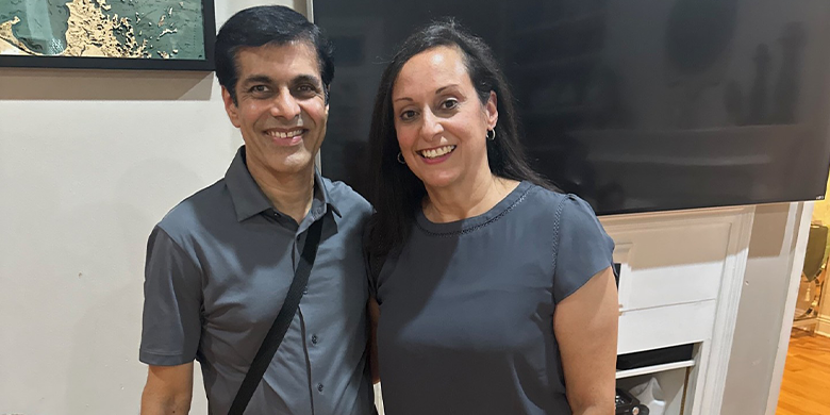
Time, Teamwork, and Specialized Neurological Care Help Amy Recover from Autoimmune Encephalitis at East Jefferson General Hospital
- Category: Neuroscience
- Posted On:

In 2019, Amy Weaver was 26 years old and enjoying the dream life she had worked hard to build. She was a certified medical technician working as a hospital microbiologist. She was engaged and planning her wedding.
“Her life was in a wonderful place, with everything she had worked for coming together,” recalled Amy’s mother, MaryBeth Burke. “Then, everything about Amy started to change.”
Amy started forgetting things and having trouble keeping up with tasks at work. She struggled with persistent nausea and vomiting. Her personality began to change.
“We had always been close,” MaryBeth said. “But suddenly, Amy didn’t want to talk to me or be around me.”
From warning signs to a medical emergency
On Father’s Day weekend, Amy was visiting with her father and shared that she didn’t feel well.
“He said he could tell,” Amy recalled. “It was clear then that I was sick, but I didn’t think it was serious.”
Just a few days later, on June 18, Amy woke up and noticed her arm was twitching.
“I immediately realized something neurological was going on and that I needed help,” Amy said. “I asked my fiancé to drive me to a hospital.”
On the way, Amy called MaryBeth and said they were on the way to the hospital closest to their house.
“I said, ‘No, you need to come to East Jefferson,’” MaryBeth recalled. “At that time, I had worked at East Jefferson for 20 years, and I knew the doctors, the staff, and our standard of care. I wanted Amy to be cared for by people I trust.”
Within minutes, Amy’s condition worsened rapidly. Her fiancé called MaryBeth back and said Amy was now refusing to come to the hospital since East Jefferson General Hospital was across the lake from where they lived.
“I told him it was no longer an option and to keep driving,” MaryBeth said. “By the time they got to East Jefferson, Amy was struggling to walk. Her face had also started twitching, and she was screaming like she was being tortured. She kept saying something was attacking her brain.”
Within a few hours, Amy had been sedated and intubated while the care team began running tests. Archibald L. Melcher, MD, a neurologist at East Jefferson General Hospital, was called in to evaluate Amy.
“Initially, the only diagnosis we had was encephalopathy, which is a general term for a condition that affects the brain’s function,” Dr. Melcher explained. “We ran multiple blood and imaging tests, checking for metabolic abnormalities, vitamin deficiencies, infections, immune-related diseases, and even rare neurological conditions.”
After nearly every test came back negative or normal, Dr. Melcher’s only clue was an MRI showing small areas of inflammation in Amy’s brain.
“We started Amy on a course of steroids to help reduce the inflammation, which helped a little,” Dr. Melcher said. “We could see a decrease in inflammation, but her face continued to twitch and her cognitive function wasn’t improving.”
Refusing to give up
As Amy’s hospitalization stretched to weeks without significant improvement, conversations about hospice care began.
“I didn’t want to think about end-of-life care for my only child,” MaryBeth recalled. “Her father and I never gave up hope, but there were moments where we had to have hard conversations and consider the possibility that she might not make it.”
Throughout Amy’s hospitalization, MaryBeth continued her work as a clinical manager for East Jefferson General Hospital’s Comprehensive Pain Management and Oncology teams.
“Many people asked how I could keep working during all of this, but my answer always was, ‘How can I not? Work is keeping me sane,’” MaryBeth said. “If I sat with her 24/7, especially during the weeks she didn’t improve, I think I would have lost hope faster.”
After more than 20 years at East Jefferson General Hospital, MaryBeth had a lot of friends, but she quickly became known as “Amy’s mom.”
“Staff I had never met would come up and ask me how Amy was doing,” MaryBeth recalled. “The hospital started a prayer chain for Amy, and every time I walked into the room, there were more gifts from people I didn’t know. Everyone was showing support in so many ways. I was grateful for the nurses, providers, and my staff. And Dr. Melcher’s care will always have a special place in my heart because he never gave up on Amy.”
Early in his career at East Jefferson General Hospital, Dr. Melcher worked with brain rehabilitation patients and saw firsthand how people with serious brain injuries can make meaningful progress over time.
“The key to the brain is time,” he said. “The brain can be damaged in a matter of minutes, but it needs much longer to heal. I knew that we had other options for treating Amy, but what her brain needed most was time.”
When the round of steroids didn’t provide significant improvement, Dr. Melcher recommended a course of intravenous immunoglobulin (IVIG), a treatment made from antibodies collected from donated plasma that helps regulate an overactive immune system response and reduce inflammation so that affected tissues can heal.
“The IVIG made a big difference,” Dr. Melcher said. “The twitching began to subside, so we were able to reduce the sedating medications, and Amy started responding more normally.”
“We were all there when Amy woke up,” MaryBeth recalled. “We couldn’t help but cry and be so grateful. We truly felt like it was a miracle.”
“I remember being asked questions as I was waking up,” Amy said. “I answered most of them correctly. When they told me I had been in a coma for over a month, I was like, ‘You’re messing with me.’ Even then, it took me a few days to realize just how serious my condition had been.”
Rebuilding her life
While no test was ever conclusive, Amy’s care team settled on a final diagnosis of autoimmune encephalitis, which occurs when the body’s immune system mistakenly attacks the brain, causing inflammation and symptoms such as changes in behavior, confusion, memory problems, abnormal movements, weakness, or loss of consciousness.
Once Amy was stable enough to leave the Neurocritical Care Unit, she was transferred to inpatient rehabilitation, where her care team helped her relearn how to walk and eat. After a month of inpatient rehab, she was discharged home to begin three months of outpatient rehab. In total, Amy was admitted for 79 days.
Just like before, Amy has worked hard to create a new life for herself. She continues to experience some long-term effects, including challenges with attention, short-term memory, multitasking, and stamina. Those changes have prevented her from returning to her work in the laboratory.
“I’ve found hobbies to keep busy,” Amy said. “I’m part of a book club, and I’m learning to fence. I volunteer at a senior center—we play a lot of bingo. I also like to find local events, like live music or trivia nights.”
But what has changed the most for Amy is her perspective on time.
“Even if you feel and seem healthy, you can end up in a hospital the next day,” Amy said. “I tell people my age and younger to not put off the things you really want to do because you don’t know how much time you have. You might not be as healthy as you are today in a few years.”
While Amy and MaryBeth credit much of Amy’s recovery to Dr. Melcher, he’s quick to give the credit to others.
“The real heroes were the Neurocritical Care Unit nurses,” he said. “They provided excellent care around the clock. And Amy worked incredibly hard during her inpatient and outpatient therapy. It is her persistence that has gotten her to where she is today.”
When a neurological emergency threatens the brain, rapid diagnosis, specialized neurological care, and coordinated teamwork can make all the difference. Click here to learn more about how East Jefferson General Hospital’s Neurocritical Care team brings together expertise, advanced technology, and compassionate support for patients and families facing complex neurological conditions.