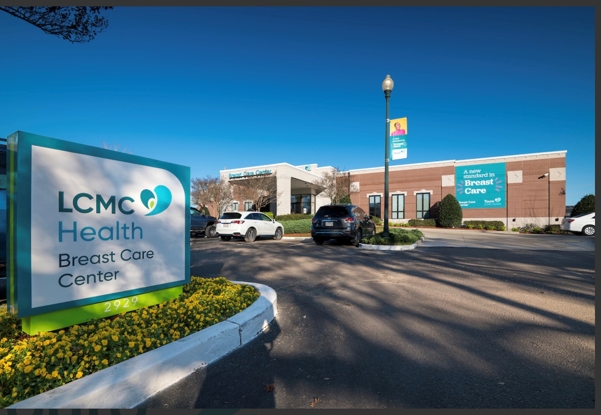
No two women are the same. Their treatment plans shouldn’t be either.
At the LCMC Health Breast Care Center, we go beyond mammograms and checkups
to provide women a collaborative and comprehensive approach to care. Our
focus on prevention, treatment, and survivorship, ensures the women in
our community receive the best care possible in a dedicated outpatient
center. From advanced technology to patient navigation and individual
care plans, Touro is setting a new standard in breast care.
For questions, or to schedule an appointment at the Breast Care Center,
call us at
504.503.6209.
The highest standard in Breast Cancer Care!
Touro is proud to be an
Accredited Breast Center by the American College of Surgeons through the National Accreditation
Program for Breast Centers.
Our diagnostic imaging services are tailored to your unique needs and designed
by a team of highly trained specialists. Our cancer diagnostic imaging
services are the first step in a cancer patient’s journey.
At the Breast Care Center, we specialize in treating breast cancer using
the most advanced medical and surgical options available. Our oncologists
work collaboratively with chemotherapy and radiation treatment specialists,
along with plastic and reconstructive surgeons, to give each patient the
best results. We also utilize oncoplastic surgery, which is an approach
to breast cancer surgery that combines plastic surgery techniques and
lumpectomy. This approach has prevented many women from requiring a mastectomy.
We also specialize in radioactive seed localized breast surgery, hidden
scar surgery, and reconstructive breast surgery. We round out our comprehensive
medical care with a range of dedicated support services to ensure you
are cared for at every stage of your breast cancer journey.
The Breast Care Center at Touro includes private consultation rooms for
support group meetings and multidisciplinary team meetings.
Breast Cancer Patient Navigation
Our Breast Cancer Nurse navigator provides individualized assistance that
helps you overcome barriers to receiving the quality and timely care you
deserve. Our nurse navigator can help you understand your breast cancer
diagnosis, explore treatment options, and connect you to the supportive
care resources at Touro and in the community. They can also provide you
with support and encouragement throughout treatment. Patient navigation
can help no matter if you’re newly diagnosed or already receiving
treatment.
You have options when it comes to breast cancer surgeries. A mastectomy
is a procedure consisting of the entire breast, as well as some nearby
tissues being removed. The goal of a lumpectomy is to conserve the breast.
During this procedure, most of the breast is kept intact. Radiation may
be necessary for a lumpectomy. Mastectomies are more extensive than a
lumpectomy. Your doctors will discuss which route would be best for you
depending on your type of breast cancer as well as the size of your tumor
and your previous treatments. It’s important to note that a mastectomy
does not provide a better chance of survival than other, more conservative
surgeries.
You have options when it comes to breast cancer surgeries. A mastectomy
is a procedure consisting of the entire breast, as well as some nearby
tissues being removed. The goal of a lumpectomy is to conserve the breast.
During this procedure, most of the breast is kept intact. Radiation may
be necessary for a lumpectomy. Mastectomies are more extensive than a
lumpectomy. Your doctors will discuss which route would be best for you
depending on your type of breast cancer as well as the size of your tumor
and your previous treatments. It’s important to note that a mastectomy
does not provide a better chance of survival than other, more conservative
surgeries.
Breast cancer reconstruction surgery can be used to restore one or both
breasts after a mastectomy, lumpectomy, or congenital deformity. This
procedure can achieve near normal shape, symmetry, and appearance of the
breasts. Reconstructive breast surgery may be performed as a single surgery
or during multiple procedures in stages. We recommend that you discuss
and plan your breast reconstruction surgery before your mastectomy. Reconstructive
breast surgery options include implant breast reconstruction and autologous
tissue flap reconstruction.
If you’re concerned about the scars associated with breast cancer
surgery, hidden scar breast cancer surgery is an excellent option. This
advanced approach involves the removal of cancerous tissue through a single
incision in an inconspicuous area to minimize visible scarring. Surgeons
preserve a natural-looking breast and the nipple, areola, and surrounding
tissue are spared. Hidden scar surgery may also ease the emotional impact
of breast cancer surgery. The procedure may be appropriate for many breast
cancer patients who are undergoing nipple sparing mastectomy or breast-conserving
procedures. Our team has performed this surgery many times and can help
you determine whether it’s right for you.
Lymphedema is swelling that may occur after cancer surgery when lymph nodes
are removed. It may also happen after radiation to the lymph nodes. It
can start months or years after treatment. It’s a long-term (chronic)
condition that has no cure. But you can take steps to help keep it from
starting. If it does start, there are things you can do to reduce or ease symptoms.
If left untreated, lymphedema can get worse. It’s important to know
what lymphedema is and what you should watch for. Lymphedema is easier
to treat and treatment is more likely going to work if it’s treated
right away.
At Touro, supportive care is an essential part of our cancer program. We
provide the mental, emotional, spiritual, and social support you need
through your cancer journey, from diagnosis through treatment and into
survivorship.
Our approach focuses on the whole person and not just the disease. Selecting
the services you need can strengthen your mind and body while empowering
you to fight cancer and recover from your treatment. We’re proud
to offer these cancer support services to patients and their families
at no cost.
Breast reconstruction procedures should be covered by your health insurance
plan, whether they are done right away, soon after mastectomy/lumpectomy,
or many years later. Check with your physician and health insurance to
see which reconstruction options are covered by your insurance.
Typically, breast reconstruction takes place during or soon after mastectomy,
and in some cases, lumpectomy. Breast reconstruction also can be done
many months or even years after mastectomy or lumpectomy. During reconstruction,
a plastic surgeon creates a breast shape using an artificial implant (implant
reconstruction), a flap of tissue from another place on your body (autologous
reconstruction), or both.
All cancer patients are different. Your doctor might recommend surgery
based on the form of cancer you have as well as the stage of the cancer
and whether or not it has spread. There are 2 basic types of surgery to
remove breast cancer:
Lumpectomy (also called breast-conserving surgery, partial mastectomy or
wide excision)
Breast cancer can happen to anyone. Having a family history increases your
risk, but 80% of all women diagnosed with breast cancer have no family
history of the disease.
Breast Cancer is the second most common cancer in women. 1 in 8 women will
develop breast cancer in their lifetime. Of those, only 10% will have
a family history of breast cancer.